


Luxury bathrooms are no longer designed only around tile, plumbing fixtures, and mirrors; in high-end homes, condos, penthouses, and renovated primary suites, the vanity is often the first element that defines the room’s tone, whether it appears as a sculptural furniture piece, a floating architectural volume, or a tailored storage system wrapped in stone, wood, metal, and integrated lighting. A luxury bathroom vanity is not simply a cabinet with a sink on top, but a custom design decision that affects storage, proportion, lighting, surface continuity, material performance, and the spa-like atmosphere of the room, which is why Luxury Italian bathroom vanities and furniture and refined custom bathroom cabinetry have become central to the way today’s most considered bathrooms are planned.
What makes a bathroom vanity truly luxury?
| Luxury Vanity Element | What It Means in Design | Why It Matters in a High-End Bathroom |
|---|---|---|
| Proportion | The vanity is scaled to the width, height, and architecture of the room, whether it is floating, full-length, double, compact, or paired with tall storage. | Prevents the vanity from feeling too small, bulky, low, or disconnected; Helps the bathroom feel designed as one complete space. |
| Architectural alignment | Drawer lines, mirror edges, wall panel seams, stone veining, lighting channels, and surrounding surfaces are planned to work together. | Creates visual calm; Reduces mismatched details; Makes the vanity wall feel intentional rather than assembled. |
| Material restraint | Wood, stone, metal, glass, lacquer, and mirror surfaces are selected with balance instead of using too many dramatic finishes at once. | Allows one or two strong materials to lead; Keeps the bathroom refined, calm, and visually controlled. |
| Stone and surface continuity | Stone countertops, backsplashes, marble-inspired panels, or large-format surfaces are coordinated with cabinetry, mirrors, and wall treatments. | Gives the vanity wall an architectural presence; Reduces visual fragmentation; Helps the bathroom feel more custom and complete. |
| Refined hardware and details | Matte, brushed, burnished, recessed, or integrated hardware supports the cabinetry without dominating the design. | Adds precision and tactile quality; Keeps the vanity face clean; Prevents decorative details from overpowering the materials. |
| Integrated mirror and lighting | Mirrors, backlighting, sconces, medicine cabinets, and under-vanity lighting are planned with the vanity instead of added afterward. | Improves daily function; Softens the room’s atmosphere; Helps wood, stone, glass, and cabinetry feel connected. |
Vanity as bespoke furniture, not a cabinet box
The furniture approach
When a vanity is treated as furniture, it gains presence. It is no longer just the place where the sink sits. It becomes the piece that gives the bathroom character. This does not necessarily mean it needs to be decorative or ornate. Some of the most refined vanity designs are extremely restrained. Their quality comes from proportion, material, finish, shadow lines, and the way each detail is resolved.
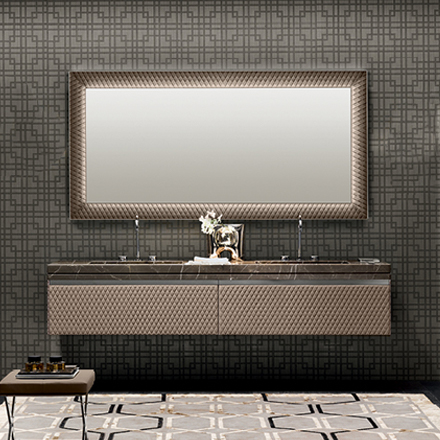
A furniture-inspired vanity may have refined legs rather than a solid base. It may use a floating structure that feels like a suspended volume. It may include a recessed toe space that makes the cabinet feel lighter. It may feature integrated handles so the drawer fronts remain clean. It may use ribbed or textured fronts to introduce depth. It may rely on rich wood grain, lacquered panels, stone surrounds, or subtle metal accents to create a sense of refinement.
The key is that the vanity should feel designed from every angle. In a luxury bathroom, even the side of the vanity matters. The reveal between the countertop and cabinet matters. The transition from stone to wood matters. The depth of the drawer fronts matters. The scale of the handles matters. These are the details that separate bespoke furniture from standard cabinetry.
This approach also allows the vanity to relate to the rest of the residence. A primary bathroom should not feel disconnected from the home’s broader design language. If the home uses Italian wall panels, refined closet systems, warm wood furniture, or architectural doors, the vanity should speak the same language. It may not use the exact same finish, but it should feel connected in tone and level of detail.
That is why custom bathroom cabinetry is so important in luxury residential design. The goal is not only to create storage. The goal is to make the bathroom feel tailored, coherent, and personal. A vanity can be minimal, sculptural, warm, dramatic, or quietly architectural, but it should never feel like a leftover cabinet placed into a finished room.
The millwork approach
The millwork approach goes one step further. Instead of thinking only about the vanity, it considers the entire vanity wall and the storage environment around it. In a luxury bathroom, bath millwork can include side towers, recessed medicine cabinets, linen storage, drawer organizers, hidden outlets, wall-hung shelves, integrated lighting, mirror surrounds, and paneling around stone or glass surfaces.
This matters because bathrooms need to hold many things while still feeling calm. Towels, skincare, hair tools, grooming products, cleaning supplies, extra toiletries, makeup, shaving items, and daily essentials all need a place. If the storage is not planned properly, the countertop becomes cluttered. Once that happens, even the most beautiful stone and cabinetry lose their impact.
Custom bath millwork solves this by designing storage around use. A shallow top drawer can hold small daily items. Deeper drawers can hold towels or larger grooming tools. Internal dividers can keep products organized. Tall side cabinets can store linens or extra supplies. Hidden outlets can keep electric toothbrushes, razors, and hair tools accessible but out of sight. A recessed medicine cabinet can provide storage without adding visual bulk to the wall.
The millwork approach also considers sink clearance and cleaning. A beautiful vanity should still be practical around plumbing, drain positions, and countertop maintenance. If drawers conflict with plumbing, storage becomes awkward. If the vanity sits too close to a side wall, cleaning becomes difficult. If the countertop overhang is poorly designed, water may collect in the wrong places. In a luxury bathroom, these functional details are part of the design quality.
Moisture is another important factor. Bath millwork must be specified for a humid environment. This does not mean wood should be avoided. It means wood, veneers, engineered panels, lacquers, and finishes must be selected and detailed properly. The vanity should be designed for daily use, steam, cleaning routines, and changing humidity conditions, especially in warm-weather and coastal markets.
When the millwork is successful, the bathroom feels effortless. The towels have a place. The grooming tools have a place. The lighting feels planned. The mirror does not look random. The stone does not feel disconnected from the cabinetry. The vanity wall becomes a complete composition, not a collection of separate decisions.
Stone tops, backsplashes, and the continuous-surface bathroom
Stone has always been associated with luxury bathrooms, but the way it is used has changed. In older renovations, stone often appeared only as a countertop or small decorative accent. In more refined contemporary bathrooms, stone is used to create continuity. It may move from the vanity top to the backsplash, continue up the wall, wrap into a side return, frame a niche, or become the feature surface behind the mirror.
Book-matched stone and large-format visual flow
Book-matched stone can turn a vanity wall into a focal point. When two slabs are mirrored so the veining opens like a pair of pages, the wall gains a sense of movement and symmetry. This can be especially powerful behind a double vanity, where the mirror, sinks, and lighting can be aligned with the stone pattern.
Even when stone is not fully book-matched, large-format visual flow matters. The veining should feel intentional. The transition from countertop to backsplash should be considered. If the stone continues behind the mirror or into side walls, the pattern should not look accidental. In a luxury bathroom, stone placement is not just material selection. It is composition.
Marble remains one of the most desired choices because of its depth, variation, and timeless association with luxury interiors. Quartzite can offer dramatic natural veining with strong visual character. Travertine can bring warmth and softness, especially in spa-inspired bathrooms. Quartz can provide more consistency and control, which may be useful when the design needs a quieter or more predictable surface. Onyx-inspired materials can create a luminous, dramatic effect, particularly in powder rooms or statement bathrooms.
There are also situations where decorative panels or stone-inspired surfaces may be considered, especially when the design calls for large visual continuity, lighter installation, or more controlled patterning. The key is to be honest about the project’s goals. Natural stone offers authenticity and unique variation. Engineered or decorative panel systems may offer greater control, easier coordination, or different practical advantages depending on the space.
For bathrooms where the vanity wall needs a strong architectural surface, marble wall panels can help create that continuous, high-end effect. In projects where the goal is a broader stone-inspired interior language, large-format marble-inspired surfaces can support a more seamless visual flow between the bathroom and the rest of the residence.
Why grout lines can reduce the luxury effect
Small tile can be beautiful, especially when it is handmade, textured, or used in the right architectural context. But in luxury vanity walls, too many grout lines can interrupt the calm effect. The eye begins to read the wall as a grid rather than a continuous surface. This can make the bathroom feel busier, especially when the vanity already includes drawer lines, mirror edges, hardware, faucets, and lighting.
A continuous stone backsplash or large wall panel behind the vanity can create a more refined backdrop. It allows the vanity to stand out without visual competition. It also makes the mirror and lighting feel more integrated. This is especially important in bathrooms where the design goal is quiet luxury, spa-like calm, or boutique-hotel refinement.
Grout lines also have practical implications. Bathrooms are humid spaces, and grout requires maintenance. While tile is still an excellent material in many wet areas, the vanity wall may benefit from fewer joints, especially in dry or splash-adjacent zones where the designer wants a cleaner visual result. Large slabs, stone-look panels, and made-to-measure wall panel systems can reduce visual fragmentation and make the room feel more tailored.
This does not mean tile should never be used. It means the material strategy should be deliberate. A shower may use tile for performance and texture, while the vanity wall uses a larger stone or panel surface for visual calm. A powder room may use a dramatic wall covering, while the primary bath uses a softer continuous stone backsplash. The most luxurious result often comes from knowing where to simplify.
Stone should work with the vanity, not overpower it
Stone is powerful. That is both its strength and its risk. A dramatic slab can make a bathroom unforgettable, but it can also overpower the vanity if the cabinetry is too busy. The relationship between stone and millwork needs balance.
If the stone has strong veining, high contrast, or a bold color story, the vanity may need to be quieter. A matte wood finish, simple drawer fronts, integrated pulls, and restrained hardware can allow the stone to lead. If both the stone and vanity are highly expressive, the room may feel restless instead of luxurious.
If the vanity wood grain is expressive, the stone may need a softer pattern. A warm wood vanity with subtle stone can create a rich but calm environment. This is often a strong choice for primary bathrooms where the goal is daily comfort rather than visual drama. The stone adds refinement, while the wood adds warmth.
Hardware should also be considered in relation to the stone. A bold brass faucet, dramatic marble, dark wood vanity, and decorative mirror can quickly become too much if not balanced carefully. In many luxury bathrooms, matte or brushed metal details work best because they add precision without competing with the stone.
The point is harmony. The vanity, stone, mirror, lighting, and wall treatment should feel like parts of one decision. A beautiful slab alone does not create a luxury bathroom. A beautiful cabinet alone does not create a luxury bathroom. The room becomes luxurious when each material supports the others.
Moisture-honest materials for humid bathroom environments
A luxury bathroom must be beautiful, but it also has to be realistic. Bathrooms are humid spaces. They deal with steam, water splashes, cleaning products, temperature changes, and daily use. A material that looks beautiful in a showroom may not be appropriate for every part of a bathroom unless it is specified and finished correctly.
This is especially relevant in coastal and warm-weather markets such as Miami, where humidity, air conditioning, ventilation, and sunlight can all affect material performance. Even in New York apartments, where space may be tighter and ventilation can vary, bathroom materials need to be chosen with care. Luxury does not mean ignoring these conditions. It means designing beautifully while respecting them.
Moisture-honest design does not avoid rich materials. It uses them intelligently. Wood, stone, lacquer, metal, glass, and wall panels can all work in a luxury bathroom when the correct finishes, locations, and installation details are considered. The key is to match the material to the zone. A vanity front, a dry wall panel, a countertop, a shower wall, and a floor surface do not all face the same level of exposure.
Wood finishes need the right specification
Wood can be one of the most beautiful materials in a luxury bathroom. It brings warmth, softness, and a furniture-like quality that tile and stone cannot always provide on their own. A wood vanity can make the bathroom feel connected to the bedroom, closet, and broader interior design of the home. It can also prevent the room from feeling too cold or clinical.
But wood in a bathroom must be specified properly. Untreated wood should not be used in wet or splash-prone zones. Finishes need to be selected for the environment. Veneers, engineered panels, sealed wood surfaces, and high-quality matte or satin finishes can all be appropriate depending on the design and performance requirements.
A well-designed wood vanity can be more stable and practical than many homeowners expect. The key is construction and finish. Engineered substrates can help maintain dimensional stability. Proper sealing can help protect the surface. Thoughtful detailing can reduce exposed edges and vulnerable joints. Good ventilation can also support long-term performance.
Natural wood tones are especially effective in spa-inspired bathrooms. Oak, walnut, smoked wood finishes, and other refined wood surfaces can bring depth without making the bathroom feel heavy. Darker woods can create a dramatic, intimate atmosphere. Lighter woods can make the space feel airy and restorative. The choice should depend on the architecture, lighting, stone selection, and desired mood.
Matte and satin finishes often feel more refined than high-gloss finishes in bathrooms because they soften reflections and make the cabinetry feel more tactile. They can also reduce the visual impact of fingerprints and water marks compared with highly reflective surfaces. This does not mean gloss has no place, but it should be used with intention.
Matte hardware and metal details
Hardware is one of the easiest places to weaken a luxury bathroom. Oversized, shiny, or overly decorative pulls can make even high-quality cabinetry feel less refined. In a custom vanity, hardware should support the design. It should feel proportionate, comfortable, and visually connected to the faucet, lighting, mirror frame, and nearby metal details.
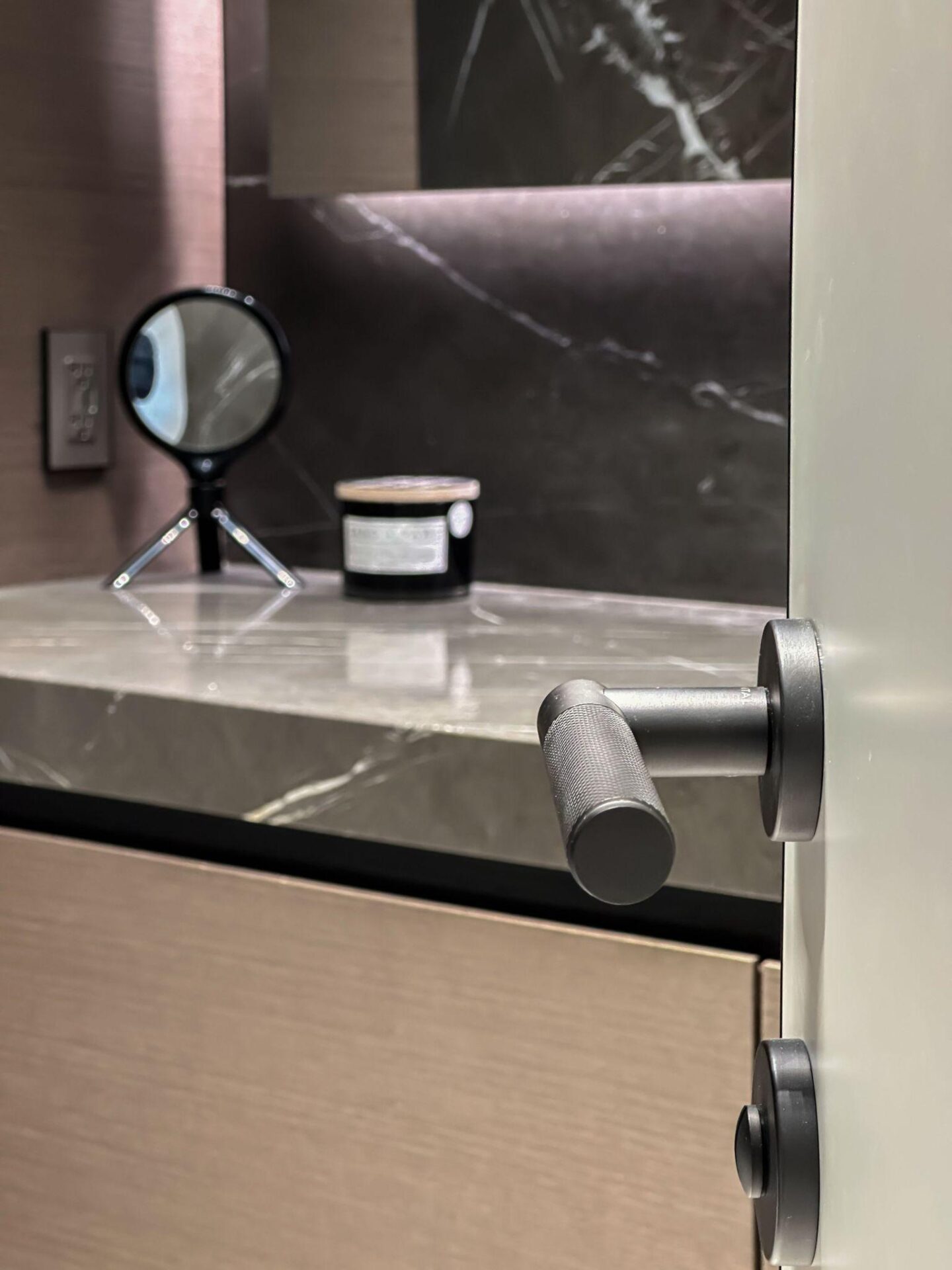
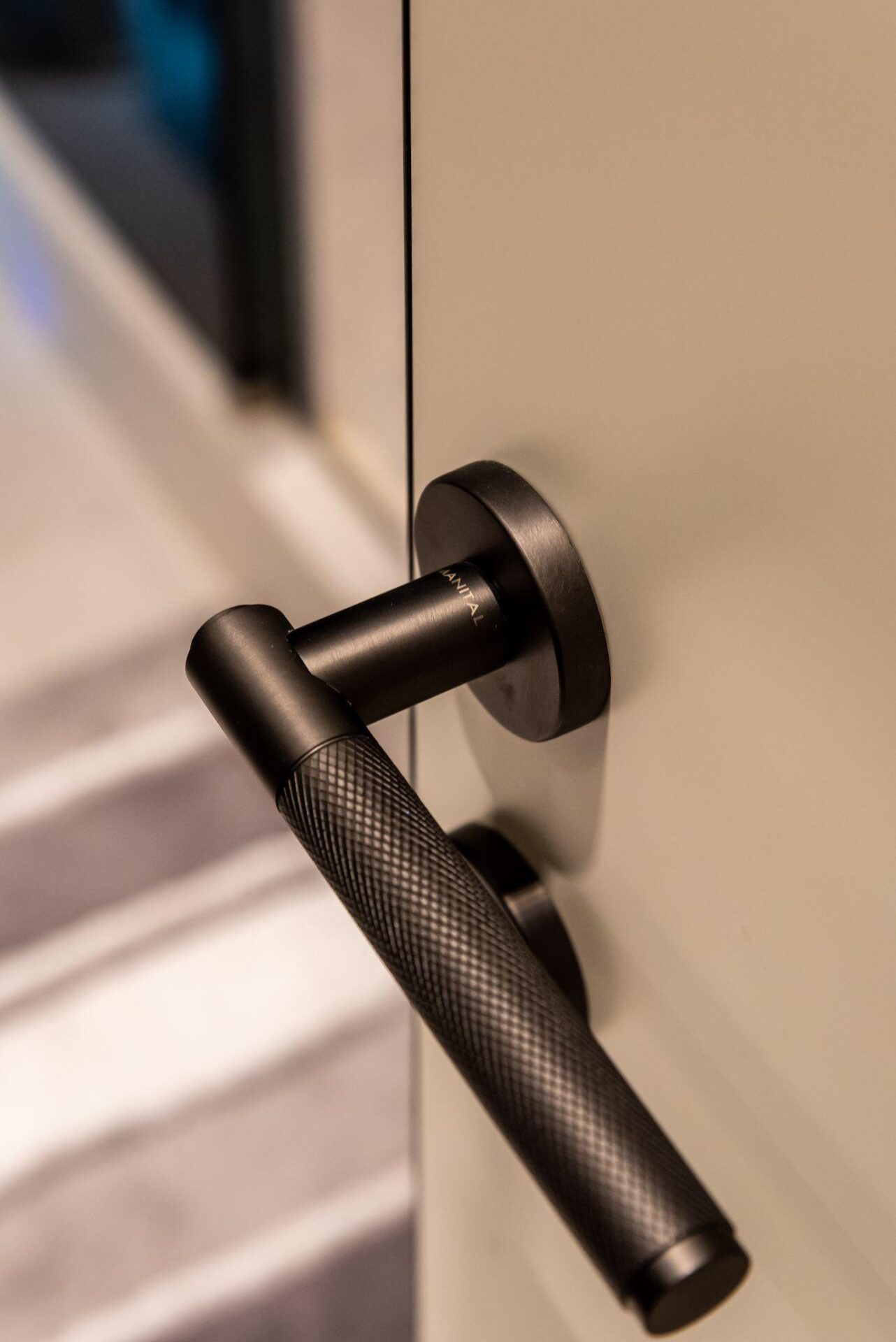
Matte, brushed, burnished, or satin metal finishes often work well because they add depth without glare. They are especially effective in bathrooms with stone, wood, and soft lighting. A brushed metal pull can add precision to a warm wood vanity. A matte black detail can create contrast in a lighter bathroom. A burnished brass or bronze tone can add warmth without feeling overly polished.
Integrated pulls are another strong option. Instead of adding hardware onto the surface, the handle is built into the drawer or door design. This keeps the vanity face clean and architectural. Recessed pulls, finger pulls, slim shadow gaps, and metal inlays can all create a more refined appearance when executed well.
Soft-close details also matter. They may not be visible in a photograph, but they affect the daily experience of the bathroom. A luxury vanity should not only look good from across the room. It should feel good when drawers open, close, and glide. That tactile experience is part of the value of custom bathroom cabinetry.
Metal details can also appear in mirror frames, shelving, lighting channels, towel bars, and side storage. These elements should be coordinated, but not necessarily identical. A bathroom can use related finishes without becoming too matched. The aim is visual harmony, not a showroom set.
Storage interiors matter as much as exterior finish
A beautiful vanity loses its impact if the countertop is always cluttered. This is why the interior of custom bathroom cabinetry is just as important as the exterior finish. Luxury is not only what the eye sees. It is also the ease of using the room every day.
The best vanity storage is planned around real routines. A person who uses skincare every morning needs different storage from someone who needs space for hair tools, shaving products, towels, or makeup. A double vanity shared by two people may need symmetrical storage, or it may need different drawer configurations on each side. A powder room may need very little storage, while a primary bathroom may need a full system.
Deep drawers can hold towels, larger bottles, and grooming tools. Shallow top drawers can hold small daily items that would otherwise crowd the counter. Drawer dividers can keep products separated and easy to find. Vertical storage can hold hair dryers, brushes, and taller items. Internal outlets can keep electric toothbrushes, razors, and styling tools charged without leaving cables visible.
Concealed bins, linen space, extra toilet paper storage, and cleaning supply compartments can also be integrated when needed. These details may not sound glamorous, but they are what allow the bathroom to stay serene. A spa bathroom depends on order. Without enough storage, the room quickly becomes visually busy.
The most useful custom vanity interiors often include:
Shallow drawers for skincare, razors, cosmetics, and daily grooming items
Deep drawers for towels, larger bottles, and hair tools
Internal dividers to prevent small items from shifting
Hidden outlets for electric toothbrushes, razors, and styling tools
Vertical compartments for brushes, dryers, and taller products
Concealed storage for cleaning supplies and backup toiletries
Linen zones for towels, robes, or washcloths
Easy-access drawers near each sink in a double vanity
This level of planning is one of the clearest differences between a standard vanity and custom bath millwork. A standard vanity asks the homeowner to adapt to the cabinet. A custom vanity adapts to the homeowner, the room, and the way the bathroom is actually used.


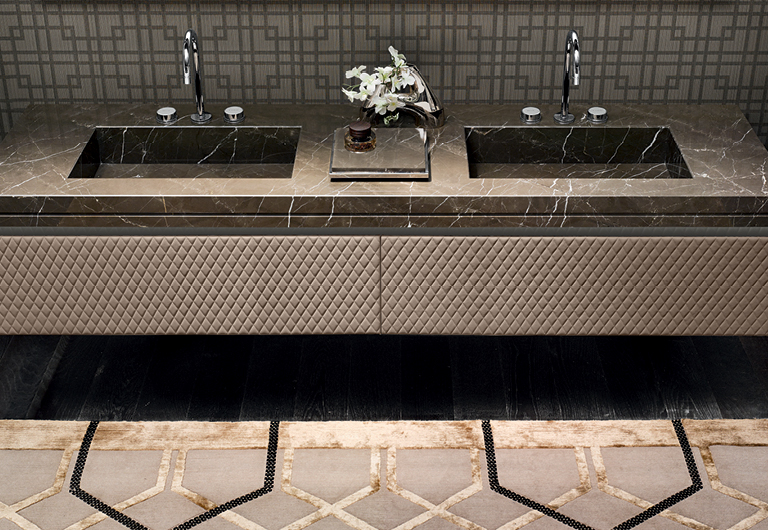
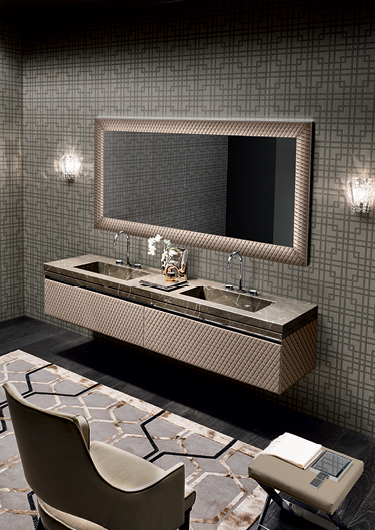
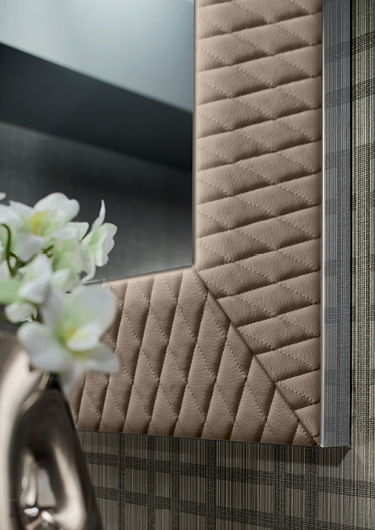
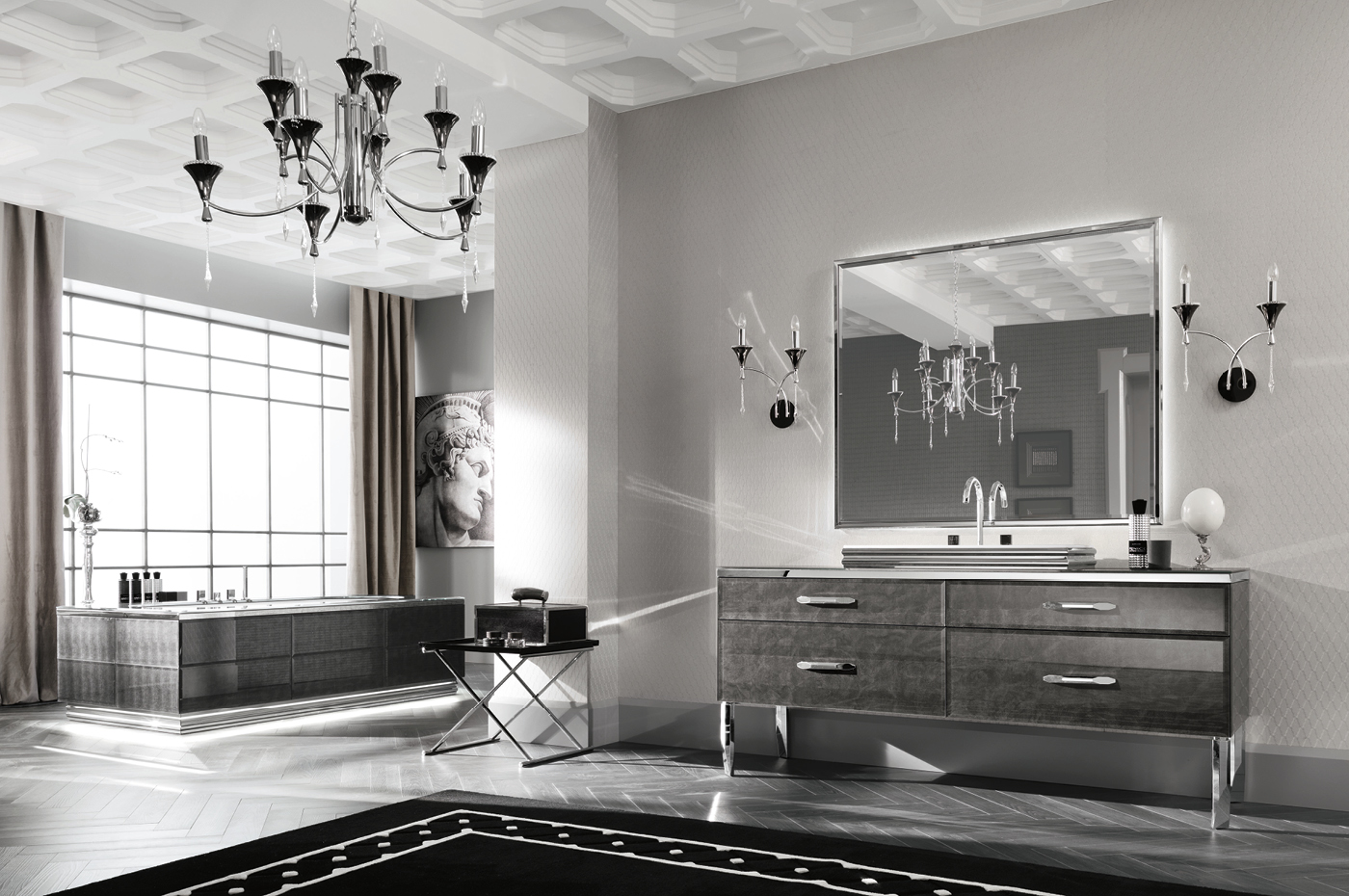
Integrated lighting turns bathroom cabinetry into architecture
Lighting is one of the details that separates a beautiful bathroom from a truly considered one. A vanity can use exquisite wood, precise cabinetry, refined stone, and custom storage, but if the lighting is treated as an afterthought, the room will never feel fully resolved. In luxury bathroom design, lighting should be planned with the vanity from the beginning because it affects the way the cabinetry is seen, the way the stone reads, the way the mirror functions, and the way the entire room feels during daily use.
This is especially clear in bathrooms where wood tones and thoughtful lighting are used together. Warm wood can make the bathroom feel calm and residential, while soft indirect lighting can add depth, shadow, and atmosphere. Instead of relying only on ceiling lights, a luxury bathroom vanity may include lighting under a floating base, inside open shelving, behind mirrors, above stone panels, within recessed niches, or along vertical wall-panel details.
The goal is not to make the bathroom overly theatrical. The goal is to create layers. One layer helps with grooming. Another layer creates calm. Another reveals the texture of the materials. When those layers work together, the cabinetry no longer feels like a box on the wall. It becomes part of the architecture.
Mirror lighting and face-level illumination
The vanity is the place where bathroom lighting must be the most practical. This is where shaving, skincare, makeup, grooming, and daily routines happen. For that reason, vanity lighting should not depend only on recessed ceiling fixtures. Overhead-only lighting can cast shadows under the eyes, nose, and chin, which makes the mirror less flattering and less useful.
Face-level lighting is usually more comfortable and more effective. Vertical sconces placed beside the mirror can illuminate the face more evenly. Backlit mirrors can soften the vanity wall and create a calm glow. Side lighting can help reduce harsh shadows. In a larger primary bathroom, layered lighting around the vanity can combine functional brightness with a more relaxed evening atmosphere.
The mirror itself should be part of the design, not a separate object added after the cabinetry is installed. A tall mirror can make the vanity wall feel more vertical. A full-width mirror can visually expand the room. A recessed medicine cabinet can add storage without interrupting the surface. A backlit mirror can make stone, wood, and cabinetry feel more connected.
In a luxury bathroom, mirror lighting should be considered alongside:
Sink placement
Faucet height and projection
Mirror width and height
Sconce location
Stone backsplash height
Cabinet depth
Drawer use
Natural light from windows
Desired mood in the morning and evening
The best vanity lighting feels effortless because the planning behind it is precise. The mirror is bright enough for daily function, but not so harsh that the bathroom loses its calm. The cabinetry is visible, but not overlit. The stone has depth, but does not glare. The result is a bathroom that works beautifully and feels refined at the same time.
Ambient lighting for the spa bathroom effect
Functional lighting is essential, but ambient lighting creates the emotional quality of the bathroom. This is where spa bathroom millwork becomes more than storage. It becomes atmosphere. Soft lighting under a floating vanity, inside a niche, along a ceiling cove, or behind a wall panel can make the room feel quieter, warmer, and more restorative.
Toe-kick lighting is especially effective under floating or recessed-base vanities. It creates the impression that the vanity is lighter and more architectural. In the evening, it can provide enough glow for the bathroom to feel usable without turning on strong overhead lights. This is one of the reasons floating vanities often feel so connected to boutique-hotel bathrooms and high-end spa interiors.
Cove lighting can add softness to the ceiling line. Wall-panel lighting can emphasize vertical rhythm or bring depth to a vanity wall. Lighting inside open shelving can make towels, objects, or decorative storage feel intentional rather than exposed. Recessed lighting above a stone panel can reveal veining without making the slab look harsh.
Ambient bathroom lighting works best when it is subtle. It should not look like a nightclub effect or a decorative trick. It should quietly support the architecture of the room. The light should help the vanity, wall panels, stone, mirrors, and cabinetry feel connected.
In a primary bathroom, this kind of lighting is especially valuable because the room is used at different times of day. Bright light may be useful in the morning, but softer light is better at night. A layered plan gives the homeowner options. The bathroom can feel crisp and functional when needed, then calm and spa-like when the goal is relaxation.
Lighting should reveal materials
Luxury materials need the right light. Wood, stone, metal, lacquer, and wall panels all change depending on how they are illuminated. A beautiful wood vanity can look flat under poor lighting. A stone backsplash can lose its depth if it is lit too harshly. Textured wall panels can disappear if the light does not create shadow. Good lighting does not compete with the materials. It reveals them.
Wood grain becomes richer when light moves softly across the surface. Matte finishes look more tactile when they are not hit with harsh glare. Stone gains depth when the veining is illuminated from the right direction. A textured wall panel becomes more dimensional when side lighting creates shadow and rhythm.
This is why lighting should be planned at the same time as the material palette. A bathroom with dramatic stone may need lighting that highlights the slab without exaggerating every vein. A bathroom with warm wood may need soft light that deepens the tone. A bathroom with decorative wall panels may need vertical or side lighting to bring out the relief.
The most successful lighting plans are often the least obvious. The homeowner may not immediately notice every light source, but they feel the result. The vanity looks warmer. The stone looks deeper. The mirror feels more comfortable. The whole room feels more finished.
Pairing custom bathroom cabinetry with wall paneling
One of the strongest luxury bathroom design moves is to stop treating the vanity, mirror, stone, and walls as separate elements. In many standard bathrooms, each part is selected independently: a vanity from one source, tile from another, a mirror from another, lighting from another, and storage wherever it can fit. The result may be attractive, but it often lacks unity.
Custom bathroom cabinetry changes that approach. The vanity wall can become one continuous composition. The cabinetry, stone backsplash, mirror, side storage, lighting, and wall treatment can all be aligned so the room feels architectural instead of assembled.
This is where wall paneling becomes extremely valuable. Paneling can add warmth, rhythm, texture, and continuity. It can connect the vanity to the wider bathroom, soften a stone-heavy space, or create a refined backdrop for mirrors and lighting. When planned correctly, the vanity no longer looks like it was installed against a finished wall. It looks like it grew out of the wall.
The continuous-surface look
The continuous-surface look is one of the clearest signs of a high-end bathroom. Instead of a vanity sitting below a mirror with unrelated tile behind it, the whole vanity wall is designed as a single surface composition. Wood paneling may frame the mirror. A stone backsplash may continue behind the sinks. Side storage may align with the vanity drawers. Lighting may be recessed into the paneling or concealed above the stone. Every line has a reason.
This type of bathroom feels more like an architectural installation than a standard renovation. The eye does not jump from one material to another. It moves smoothly across the vanity, wall, mirror, stone, and storage. That visual calm is one of the reasons luxury bathrooms feel more expensive even when they are not overly decorative.
A continuous vanity wall may include:
A floating or floor-standing custom vanity
A stone countertop and backsplash
Wood or lacquered wall panels
A full-width or vertical mirror composition
Side towers or recessed storage
Integrated lighting above, behind, or below the vanity
Aligned drawer fronts, panel seams, and stone edges
The value of made-to-measure wall panel systems is that they allow the bathroom wall to be treated as part of the design language, not merely a background. This is especially important in primary suites, powder rooms, and luxury residential bathrooms where the vanity wall is the main visual feature.
Where paneling works in a bathroom
Wall paneling can work beautifully in bathrooms, but it must be used intelligently. Not every surface in a bathroom faces the same level of moisture. A shower wall, a wet floor, a vanity splash zone, a dry entry wall, and a dressing area all have different requirements. Luxury design depends on matching the material to the correct location.
Paneling is especially effective around vanity walls, dry zones, bathroom entry walls, powder rooms, primary bathroom dressing areas, and spaces outside direct water exposure. In these areas, wood, lacquer, textured panels, decorative wall systems, and stone-inspired surfaces can add depth without compromising the practical needs of the room.
In a powder room, paneling can be more expressive because there is typically less steam and no shower. A rich wall panel behind a sculptural vanity can create a dramatic guest experience. In a primary bathroom, paneling may be quieter and more integrated, especially if the goal is a calm spa-like atmosphere. In a vanity zone, paneling can frame the mirror, connect with tall storage, or balance the visual weight of stone.
Material specification matters in wet and humid areas. The finish, substrate, edge detailing, ventilation, installation, and distance from direct water exposure all influence the final decision. A luxury bathroom should not simply borrow materials from a living room and place them in a humid environment without adjustment. The design must be beautiful, but it must also be honest about how the room will be used.
Boutique-hotel inspiration for residential bathrooms
Many luxury homeowners now want their primary bathroom to feel like a private retreat with the atmosphere of a refined hotel suite. This does not mean copying commercial hotel design. It means borrowing the qualities that make boutique-hotel bathrooms feel memorable: warm materials, layered lighting, uncluttered counters, integrated storage, soft textures, and a vanity wall that feels visually complete.
A boutique-hotel-inspired residential bathroom often has a strong focal point. That may be a floating vanity with underlighting, a stone backsplash behind a full-width mirror, a warm wood cabinet wall, or a powder room vanity wrapped in rich material. The room feels curated, but not overdecorated. Everything has a place. The countertop stays clear. The lighting creates mood. The materials feel tactile.
For a private residence, comfort matters even more than drama. A hotel bathroom is used briefly. A primary bathroom is used every day. That means the design must support real routines: towels, skincare, grooming tools, outlets, cleaning, storage, and ventilation. The best residential version of the boutique-hotel look combines atmosphere with practicality.
This is why custom bath millwork is so important. It gives the bathroom the visual strength of a hotel suite while still adapting to the homeowner’s life. The vanity wall can be memorable, but the storage remains hidden. The lighting can feel atmospheric, but the mirror still works properly. The stone can be dramatic, but the cabinetry keeps the room usable.
Italian bathroom vanity design: restraint, proportion, and material richness
An Italian bathroom vanity does not have to be ornate. In many contemporary luxury homes, the Italian influence appears through restraint, proportion, craftsmanship, surface refinement, and the relationship between materials. The design may be minimal, but it should never feel empty. It may be quiet, but it should still have depth.
This is where Italian design is especially powerful in the bathroom. It can make practical elements feel elegant without turning them into decoration. Cabinetry becomes more precise. Wood feels more refined. Stone feels more architectural. Hardware becomes slimmer. Lighting becomes integrated. The bathroom becomes less about individual products and more about the atmosphere created by proportion and material quality.
A luxury Italian bathroom vanity often succeeds because it feels balanced. It may combine warm wood with stone, matte cabinetry with metal accents, or a floating form with a strong wall surface. The beauty is not only in the materials themselves, but in the way they are composed.
Warm wood, stone, and quiet contrast
Warm wood tones can make a luxury bathroom feel serene. They soften stone, glass, metal, and mirrors, creating a space that feels more residential and less clinical. This is especially important in primary bathrooms, where the goal is often calm rather than spectacle. A wood vanity can make the bathroom feel connected to the bedroom, closet, or dressing area.
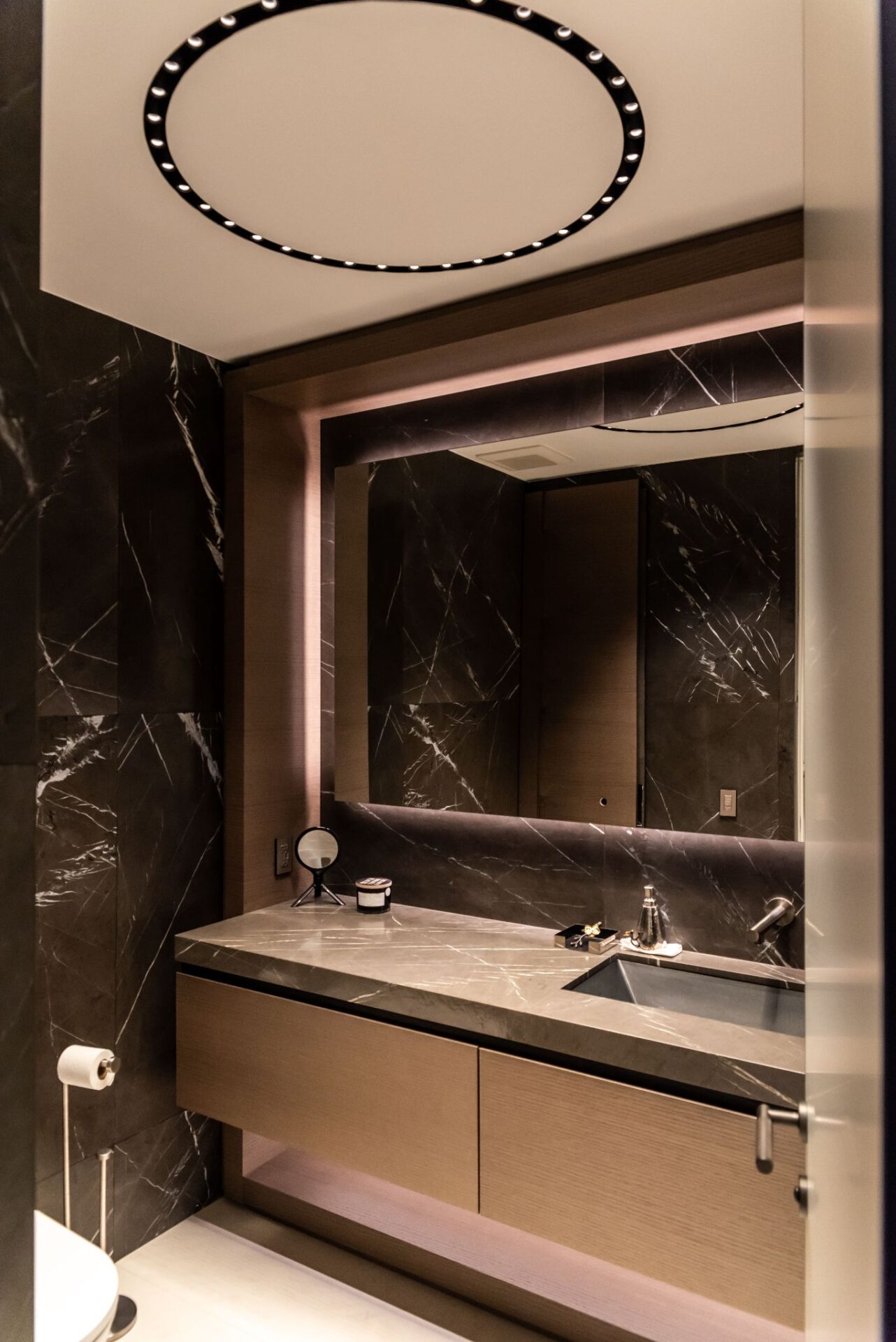
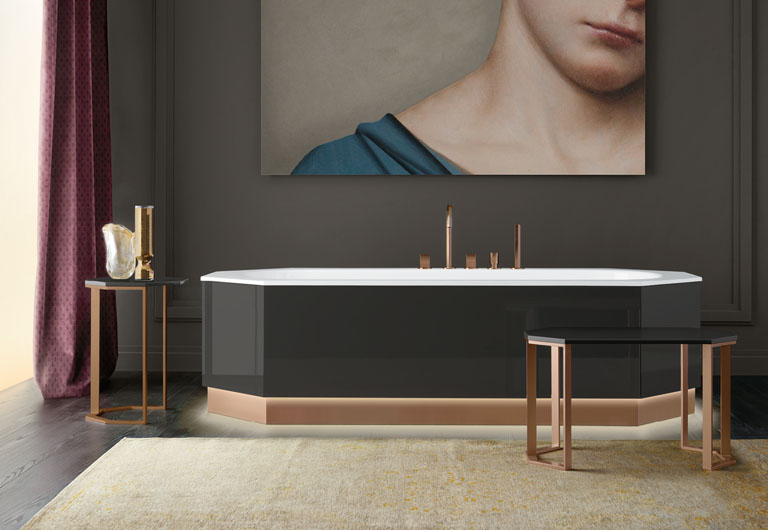
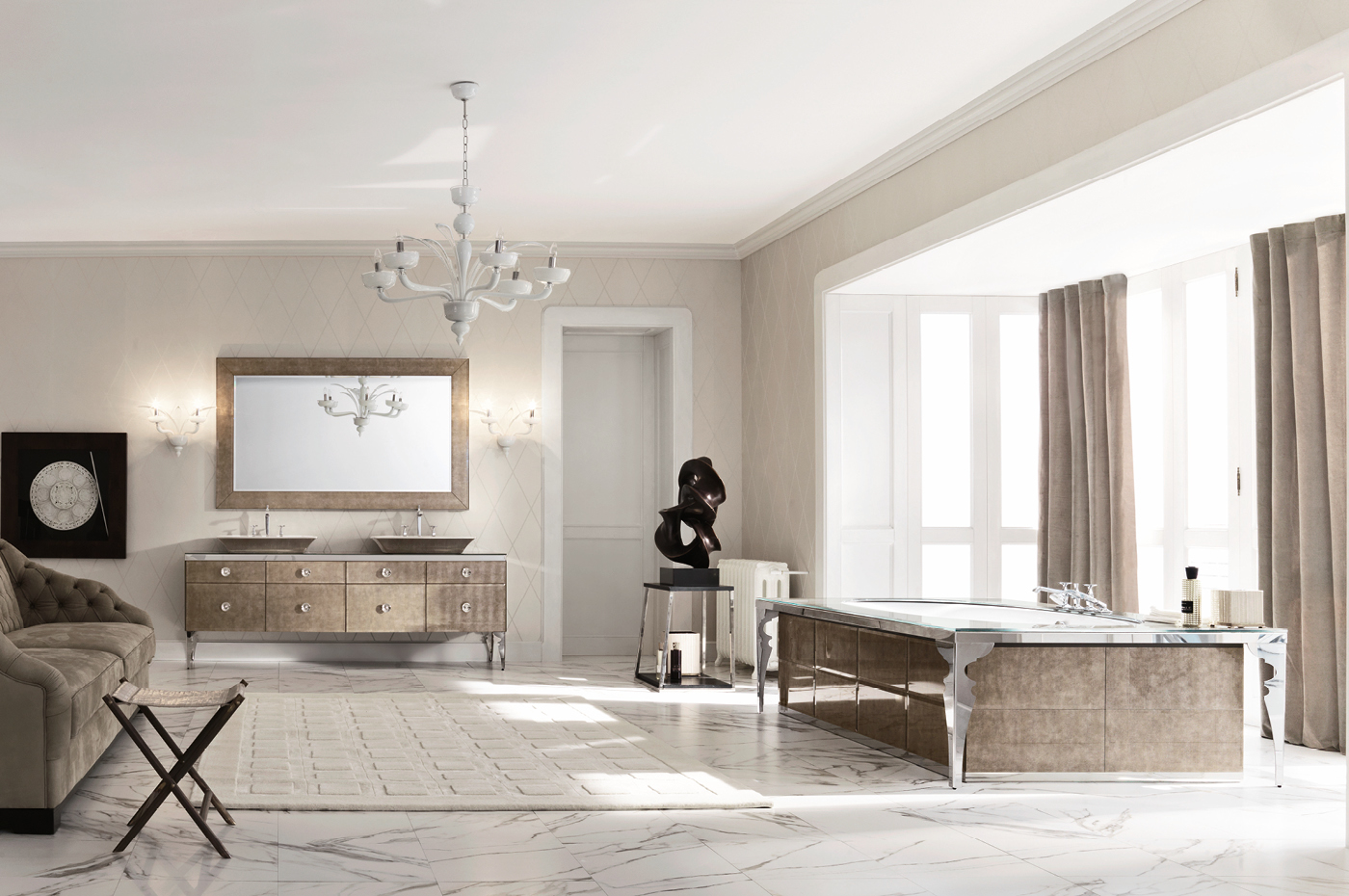
A modern bathroom project can show how wood tones and lighting create warmth, depth, and a tranquil atmosphere. When the vanity, lighting, and wall surfaces are coordinated, the bathroom feels more like a private suite than a purely functional room.
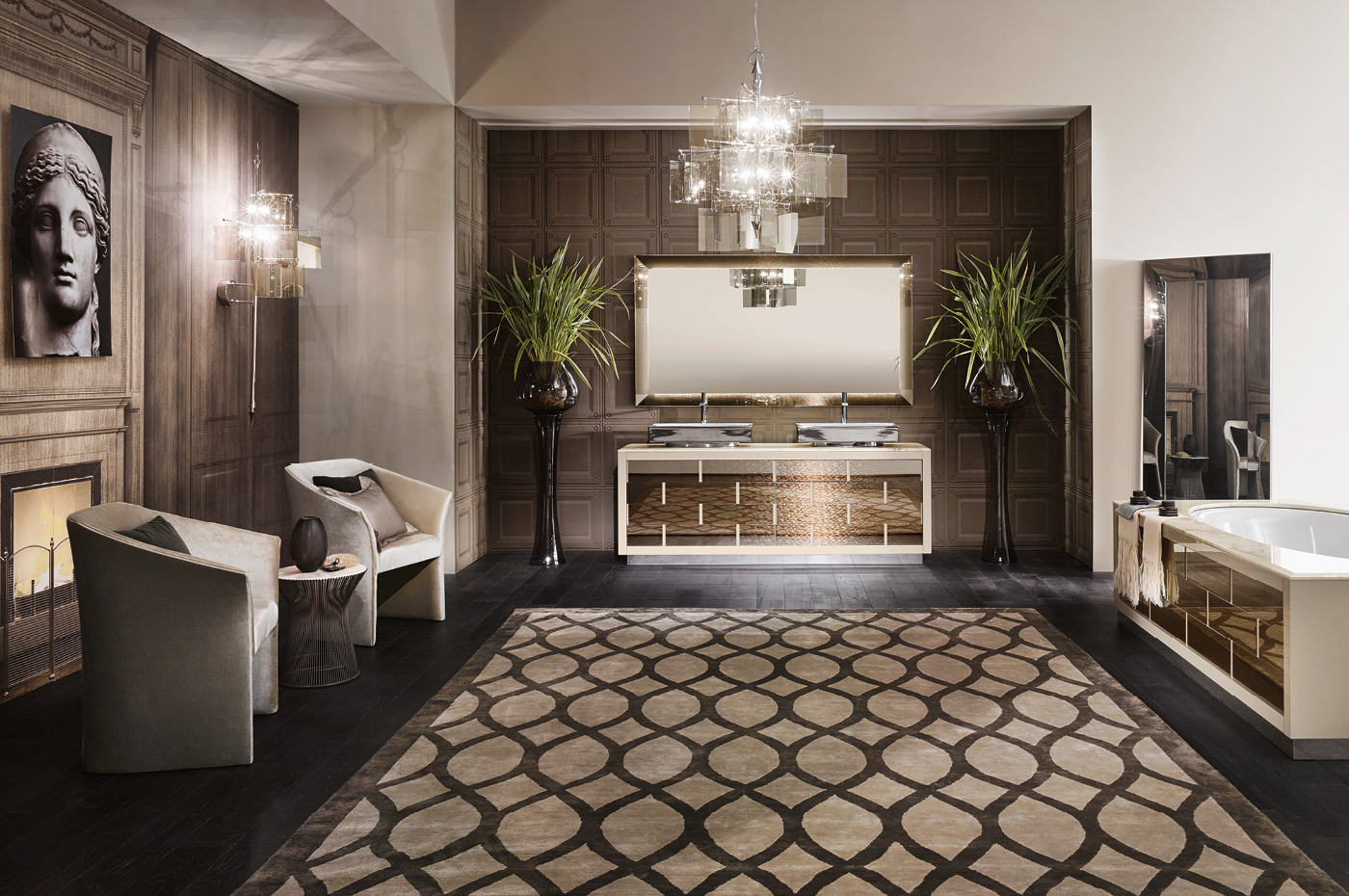
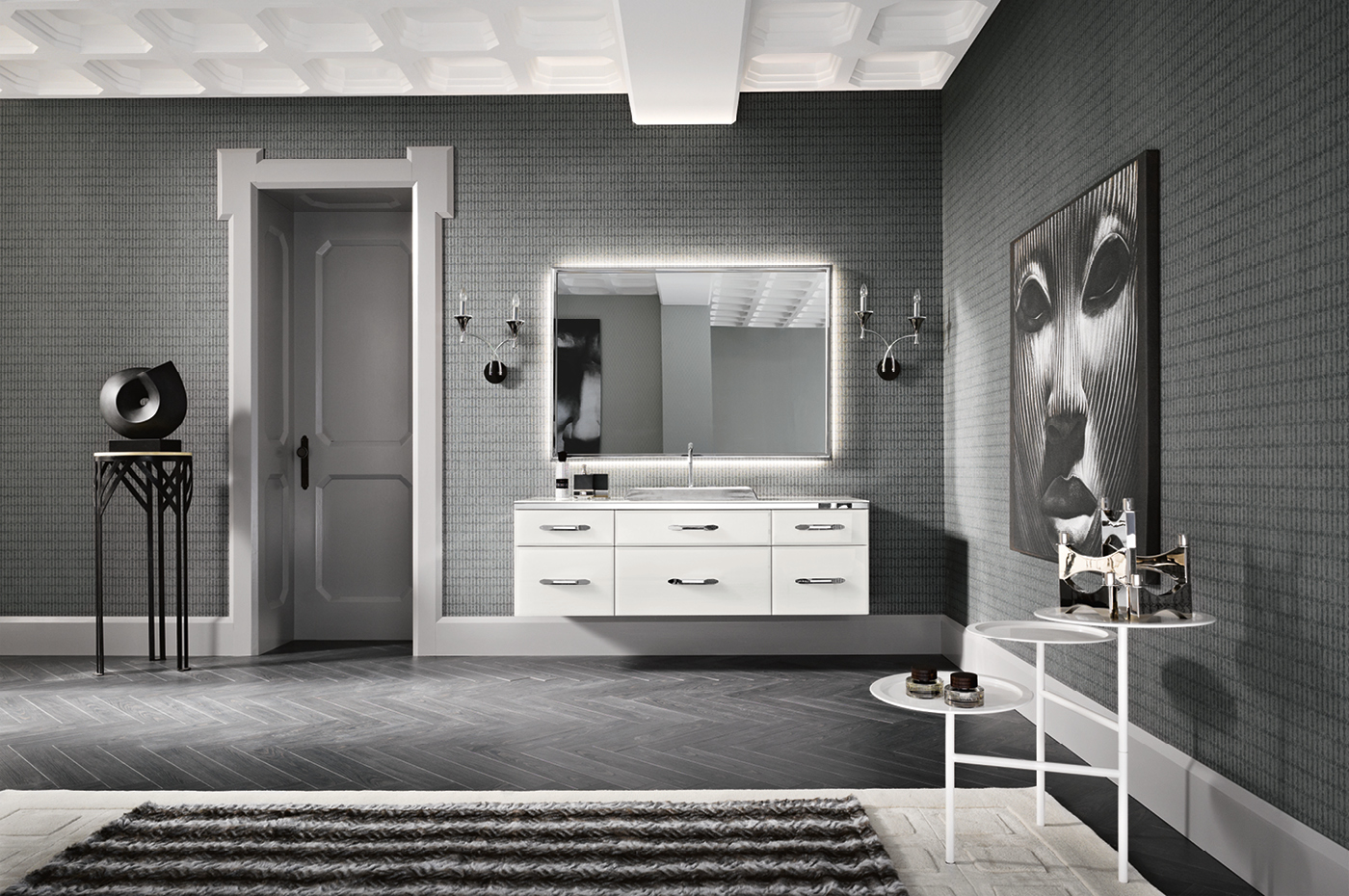
Darker stone or quartz can create a different mood. It can make the bathroom more dramatic, intimate, and refined. A contemporary bathroom design may use stronger contrast to create visual impact while still remaining clean and controlled. This approach works especially well when the cabinetry is simple and the lighting is carefully planned.
Quiet contrast is often more effective than extreme contrast. A warm wood vanity against a soft stone wall can feel rich without being loud. A dark countertop on a lighter vanity can create definition without becoming heavy. A matte metal detail can sharpen the composition without taking over the room.
The most refined bathrooms usually avoid the mistake of making every material compete. If the stone is bold, the wood can be calm. If the wood is expressive, the stone can be softer. If the lighting is dramatic, the hardware can stay understated. Italian bathroom design often works because the balance is disciplined.
Customization without visual clutter
Luxury customization should not make the bathroom busy. The best custom bathroom cabinetry hides complexity behind a calm exterior. The homeowner may need storage for towels, skincare, hair tools, grooming products, cleaning supplies, extra toiletries, and daily essentials, but the room should not reveal all that activity at once.
This is the value of well-planned custom cabinetry. Outlets can be hidden inside drawers. Organizers can be built into the interior. Plumbing access can be planned without sacrificing storage. Medicine cabinets can be recessed. Lighting can be integrated into mirrors, shelves, or wall panels. Linen storage can be placed in tall side cabinets. The vanity can look serene because the functional complexity has been absorbed into the design.
Customization should also support proportion. A custom vanity can be scaled to the exact wall width instead of relying on a preset size. Drawer heights can be adjusted to the items being stored. Stone can be selected and cut to align with the mirror and cabinetry. Wall panels can be planned around the vanity rather than installed afterward.
This creates a bathroom that feels personal without feeling overdesigned. The homeowner gets a room tailored to their routine, but the visual result remains clean, refined, and architectural.
What to consider before choosing a custom luxury bathroom vanity
Before selecting a custom luxury bathroom vanity, it is important to think beyond style. The most successful vanity is not simply the one with the most beautiful finish. It is the one that fits the room, supports the daily routine, works with the plumbing, coordinates with the lighting, and improves the overall design of the bathroom.
A showroom visit or design consultation becomes much more productive when the main decisions are already clear. The homeowner does not need to know every technical answer, but they should understand what kind of bathroom they want to create: open and spa-like, warm and residential, dramatic and stone-focused, compact and efficient, or fully integrated with the primary suite.
Key points to consider include:
Vanity width and room proportions
Floating vs floor-standing construction
Single sink vs double sink
Stone top and backsplash strategy
Drawer and cabinet storage needs
Integrated lighting and mirror design
Wall paneling or stone feature wall
Moisture-resistant material specification
Hardware and metal finish
Coordination with closets, doors, bedroom furniture, and adjacent millwork
The vanity width should be based on the room, not only on the number of sinks. A double vanity can be useful, but it must have enough counter space and storage to feel comfortable. A single wide sink can sometimes feel more elegant in a smaller bathroom than two crowded sinks.
Plumbing location also matters. Wall-mounted faucets, undermount sinks, vessel sinks, and integrated stone basins all affect drawer depth, countertop design, and mirror placement. Storage needs should be discussed early because they influence the internal layout of the cabinetry.
Lighting should be planned before the vanity is finalized. Mirror lighting, under-vanity lighting, side lighting, and ambient lighting may all require coordination with the cabinetry and walls. The same is true for wall paneling and stone surfaces. If the vanity is meant to align with panels, slabs, mirrors, or tall cabinets, those details should be planned together.
Finally, the vanity should be considered in relation to the rest of the home. In a luxury residence, the bathroom does not need to match every room exactly, but it should feel connected. The finish, hardware, wall panels, and stone palette should make sense beside the bedroom, closet, dressing area, and adjacent millwork.
| Bathroom Type | Best Vanity Strategy | Key Design Focus |
|---|---|---|
| Primary bathroom | Use a complete custom vanity composition with double sinks or a wide single-sink layout, full-width mirrors, stone backsplash, concealed outlets, deep drawers, and linen storage. | Balance daily function with calm luxury; Keep storage close to the routine; Coordinate cabinetry, stone, mirror, and lighting with the full primary suite. |
| Powder room | Choose a more expressive vanity, such as a sculptural piece, dramatic stone vanity, rich wood cabinet, floating vanity, or backlit mirror composition. | Create impact in a small space; Let one strong material or design idea lead; Avoid too many competing decorative elements. |
| Miami condo bathroom | Use a floating vanity, warm wood tones, soft stone or stone-look panels, matte metal details, efficient drawers, and moisture-aware finishes. | Preserve openness and floor visibility; Control glare from strong natural light; Add storage without making the bathroom feel heavy. |
| NYC apartment bathroom | Choose compact custom cabinetry with a wall-mounted or floating vanity, recessed medicine cabinets, vertical storage, and a continuous stone or panel surface. | Maximize every inch; Use height instead of width where possible; Create refinement without crowding the room. |


Why custom bath millwork is worth it in a luxury renovation
Custom bath millwork is most valuable when the bathroom needs more than a standard vanity size or finish. That is often the case in luxury renovations. The room may have unusual dimensions, a strong architectural concept, tall ceilings, limited space, a dramatic stone wall, or a need for highly specific storage. A standard vanity can rarely solve all of those conditions elegantly.
Custom millwork allows the bathroom to be planned around the homeowner’s habits, the designer’s material palette, and the architecture of the home. It can make the room more useful, more beautiful, and more coherent. It can also prevent the common problem of a luxury bathroom feeling like a collection of expensive but unrelated products.
Better use of space
Bathrooms often contain awkward corners, narrow walls, plumbing constraints, tall ceilings, and storage needs that standard cabinets do not address well. Custom bath millwork can respond to those conditions directly.
In a narrow bathroom, a custom vanity can be shallower without feeling cheap. In a wide primary bathroom, a longer double vanity can be scaled properly. In a tall bathroom, vertical storage can connect the vanity to the architecture. In a bathroom with limited closet space, integrated linen storage can reduce clutter elsewhere.
Hidden storage is one of the most important benefits. A custom vanity can include drawers for daily items, deep compartments for towels, vertical storage for grooming tools, concealed outlets, and side cabinets for overflow products. This makes the bathroom easier to use and easier to keep visually calm.
Better material continuity
Custom bath millwork also improves material continuity. The vanity can align with wall panels, marble panels, closet finishes, bedroom furniture, doors, or the home’s overall millwork language. This is especially important in primary suites, where the bathroom is often connected visually or physically to the bedroom and dressing area.
A standard vanity may offer a pleasant finish, but it may not coordinate with the rest of the residence. Custom millwork can use a more intentional palette. The wood tone can relate to closet cabinetry. The stone can connect to a feature wall. The hardware can coordinate with door hardware or lighting. The paneling can continue the same architectural rhythm used elsewhere in the home.
This is why residential custom millwork is so important in high-end homes. In a bathroom, the value is not only in craftsmanship. It is in the ability to make the vanity, storage, wall surfaces, lighting, and adjacent rooms feel like parts of one design language.
Better long-term design value
A luxury bathroom renovation should not feel trend-dependent. Decorative vanity styles can date quickly when they rely too heavily on a single fashionable color, hardware shape, or surface trend. Good proportion, durable materials, integrated lighting, and tailored storage have longer design value because they improve the way the room functions and feels.
Custom bath millwork supports that kind of longevity. It can be quiet enough to age well, but detailed enough to feel special. It can use rich materials without becoming excessive. It can hide daily clutter, which helps the bathroom remain calm over time. It can adapt to the architecture instead of forcing the architecture to accept a preset product.
The best luxury bathroom vanity does not need to shout. It needs to feel right every day. It should be beautiful in the morning, practical during a busy routine, calm in the evening, and refined years after the renovation is complete.
Bringing the luxury bathroom together with MATERIA Collection
MATERIA Collection’s bathroom offering is not limited to a single vanity product. It can support a complete luxury bath concept through Italian designer bathroom vanities, customizable furniture, cabinet systems, wall panel systems, stone-inspired surfaces, lighting, and bespoke design coordination.
That complete approach matters because a luxury bathroom is never defined by one element alone. The vanity may be the centerpiece, but the final result depends on how it works with the wall, mirror, stone, storage, lighting, and surrounding rooms. When those elements are planned together, the bathroom feels tailored, calm, and architectural.
For Miami residences, this can mean warm materials, floating vanities, moisture-aware finishes, stone surfaces, and cabinetry that holds its elegance in strong natural light. For New York City homes, it can mean compact custom storage, precise proportions, integrated lighting, and millwork that makes every inch feel intentional.
Explore MATERIA Collection’s luxury bathroom furniture, Italian vanities, cabinet systems, and wall panel solutions for a primary bathroom that feels tailored, calm, and architectural.
Frequently Asked Questions - Luxury Bathroom Vanities & Custom Bath Millwork
What makes a bathroom vanity luxury?
A luxury bathroom vanity combines proportion, material quality, storage design, refined hardware, stone or wall-surface coordination, and precise installation. It should feel integrated with the room, not placed into it as a separate cabinet.
Is a floating vanity better for a luxury bathroom?
A floating vanity is better when the goal is openness, visual lightness, and a spa-like atmosphere. Floor-standing and full-height cabinetry may be better when the bathroom needs more storage, stronger presence, or vertical structure.
What materials work best for a custom bathroom vanity?
Properly specified wood, veneers, stone, quartz, marble-inspired panels, metal details, and sealed matte or satin finishes can all work well. The best choice depends on humidity, ventilation, daily use, and the desired design mood.
Can bathroom wall paneling be used around a vanity?
Yes, wall paneling can work beautifully around vanity walls, dry zones, powder rooms, and primary bathroom dressing areas. Material selection, finish quality, ventilation, and moisture exposure should always be considered.
What is the difference between a standard vanity and custom bathroom cabinetry?
A standard vanity is selected from preset sizes, finishes, and configurations. Custom bathroom cabinetry is designed around the room’s proportions, storage needs, plumbing, lighting, wall surfaces, and overall architectural composition.
Does MATERIA Collection offer Italian bathroom vanities?
Yes, MATERIA Collection offers luxury Italian designer bathroom vanities and customizable bathroom furniture solutions, with showroom access in Miami and New York City.